

Does it feel like you’re walking on a pebble, with burning pain in the ball of your foot that shoots into your toes?
What Is Morton Neuroma?
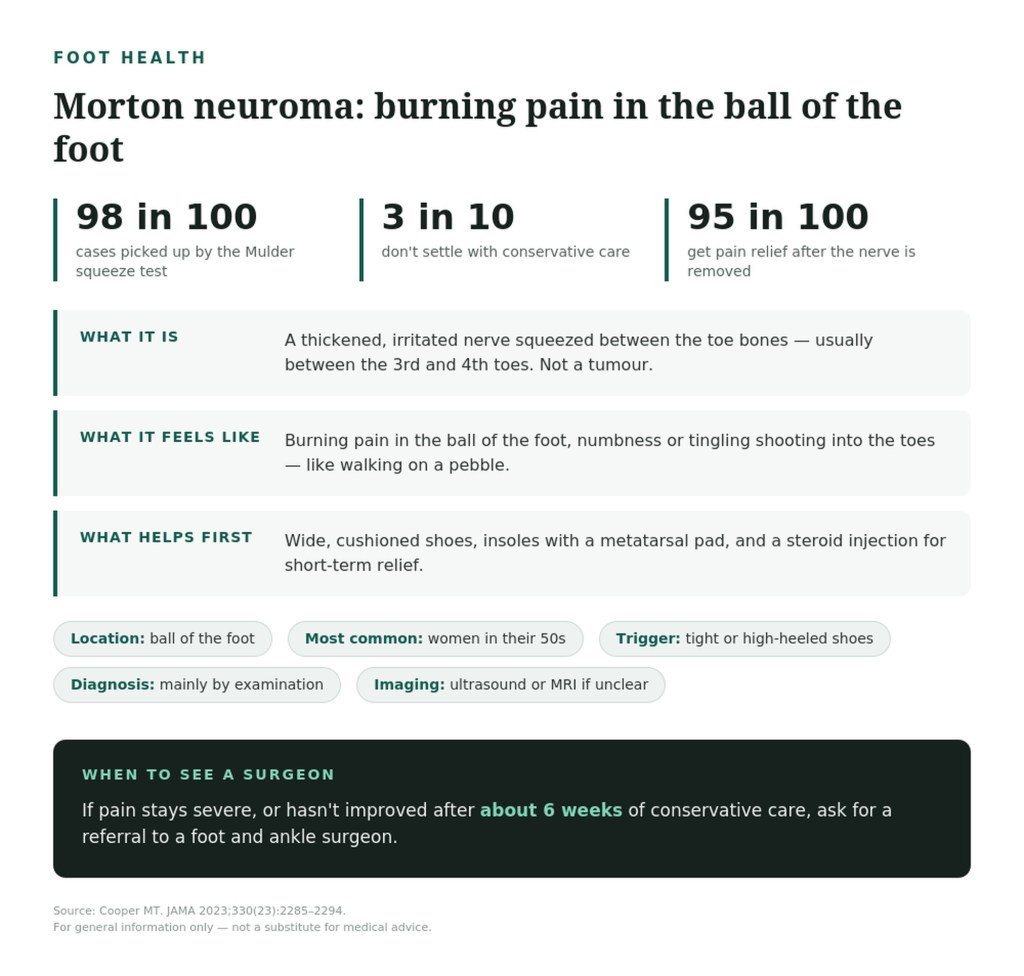
Morton neuroma is not actually a tumour, despite the name. It is a thickening and scarring of one of the nerves that runs between the long bones of the foot (the metatarsals). The nerve gets squeezed between the bones with every step, which is why the pain is worst when walking or standing, and eases when you take your shoes off and rest. It most often sits in the space between the third and fourth toes, sometimes between the second and third. It mainly affects women in their 50s, and tight shoes or high heels make it worse.
How Is It Diagnosed?
Diagnosis is mainly by examination — most people do not need a scan. Your doctor will press on the space between the toes, which is usually tender, and may do two bedside tests:
- The Mulder test: squeezing the forefoot from side to side produces a click you can feel — and sometimes hear — as the thickened nerve slips between the bones. It picks up about 98 in 100 cases.
- The Tinel test: tapping over the nerve on the sole of the foot reproduces the tingling or shooting pain.
The clinical diagnosis is reliable: when the nerve is later removed and examined under the microscope, nearly 98 in 100 turn out to be a true neuroma. Weight-bearing X-rays are sometimes done to rule out other causes such as a stress fracture or loss of blood supply to a bone. If the examination alone is not clear enough, ultrasound or MRI can confirm it — the two are similarly good. Ultrasound picks up about 91 in 100 neuromas, and MRI about 90 in 100, almost never giving a false positive. On ultrasound the neuroma looks like a dark, poorly defined lump sitting between the bones.
What Helps First?
Most people improve without surgery. Three things form the first line of treatment:
- Footwear: shoes with a wide toe box and more cushioning, and no high heels.
- Insoles: metatarsal pads or custom-made foot orthoses. In a randomised trial, custom orthoses cut pain from about 6 to about 3 on a ten-point scale over two years, compared with about 6 to about 5 with flat insoles.
- Steroid injection: usually guided by ultrasound, it brings relief for a week to three months. In a trial, steroid plus local anaesthetic improved foot-health scores by about 14 points more than anaesthetic alone at three months. But nearly 3 in 10 people who have injections eventually need surgery anyway.
Other options have thinner evidence behind them: shockwave therapy, mobilisation of the foot, and radiofrequency or alcohol treatment to quieten the nerve. A Cochrane review found only limited trial evidence for many of these, and even steroid injection itself is not firmly proven.
When Is Surgery Considered?
If the pain stays severe, or has not improved after about six weeks of conservative care, it is time to ask for a referral to a foot and ankle surgeon. There are two operations. The traditional standard is neurectomy — removing the affected nerve — which relieves pain in more than 95 in 100 people. The alternative is neurolysis — freeing the nerve without removing it — which preserves nerve function. A review of the evidence found injections leave fewer people fully satisfied than either operation, and the two operations perform about equally well.
The Bottom Line
Morton neuroma is a squeezed, thickened nerve in the ball of the foot — not a tumour. Most people improve with wider shoes, insoles and sometimes a steroid injection, and surgery, when it is needed, works very well.
References
- Cooper MT. Common Painful Foot and Ankle Conditions: A Review. JAMA. 2023;330(23):2285-2294.
- Padua L et al. Relationship Between Sensory Symptoms, Mulder’s Sign, and Dynamic Ultrasonographic Findings in Morton’s Neuroma. Foot Ankle Int. 2020;41(12):1474-1479.
- Urits I et al. Injection Techniques for Common Chronic Pain Conditions of the Foot: A Comprehensive Review. Pain Ther. 2020;9(1):145-160.
- Naraghi R et al. Plantar Pressure Measurements and Geometric Analysis of Patients With and Without Morton’s Neuroma. Foot Ankle Int. 2018;39(7):829-835.
- Díaz-Fernández R et al. Radiofrequency Ablation for Interdigital Neuroma: Moderate 2-Year Outcomes and Surgical Conversion Rate. Foot Ankle Int. 2026.
- Matthews BG et al. Treatments for Morton’s neuroma. Cochrane Database Syst Rev. 2024.
- Lu VM et al. Treating Morton’s neuroma by injection, neurolysis, or neurectomy: a systematic review and meta-analysis of pain and satisfaction outcomes. Acta Neurochir (Wien). 2021;163(2):531-543.





Leave a Reply