
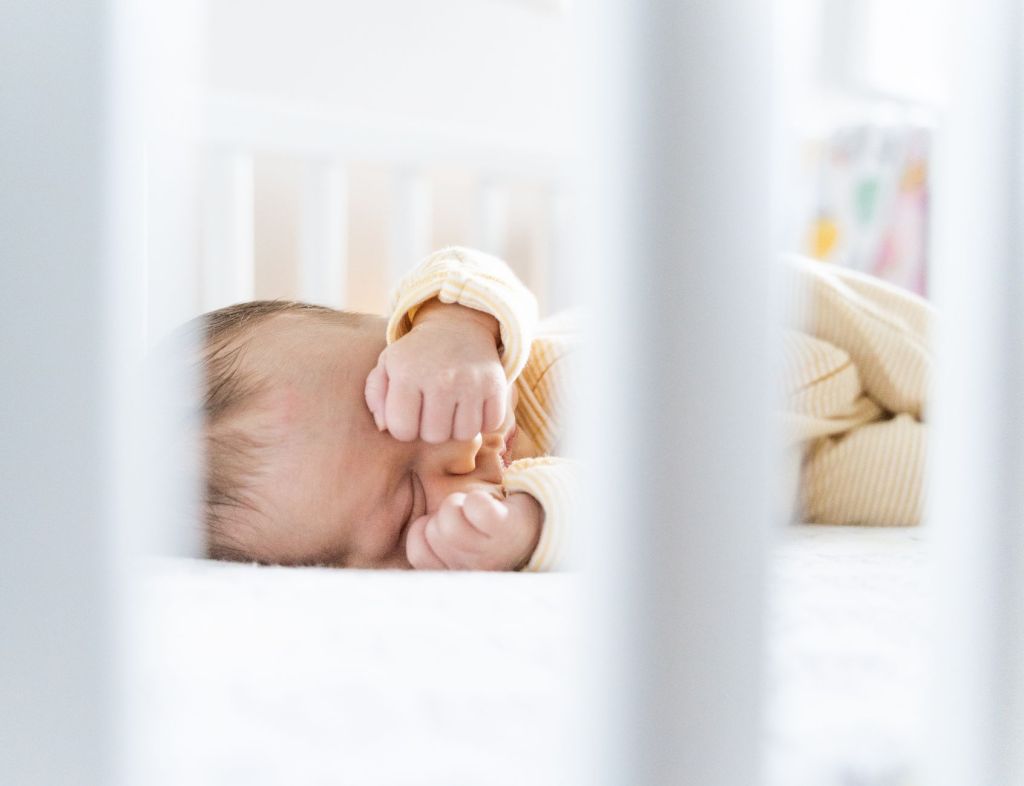
Is it okay to let your baby “cry it out” at bedtime?
Few parenting topics spark as much debate as sleep training. Some parents swear by it; others worry it harms their baby’s emotional bond. Here’s what the research actually shows — and how to decide if it’s right for your family.
What Sleep Experts Recommend
The American Academy of Sleep Medicine (AASM) reviewed the evidence on bedtime problems and frequent night waking in young children and found that “extinction-based” methods — commonly called sleep training — work well as a first-line approach. They’re usually started from around 4–6 months of age, when most babies can settle themselves and no longer need night feeds.
The goal is to help your baby fall asleep on their own, rather than relying on rocking, feeding or holding to drift off. Babies who can settle themselves tend to protest less at bedtime and wake less often overnight.
Two Main Approaches
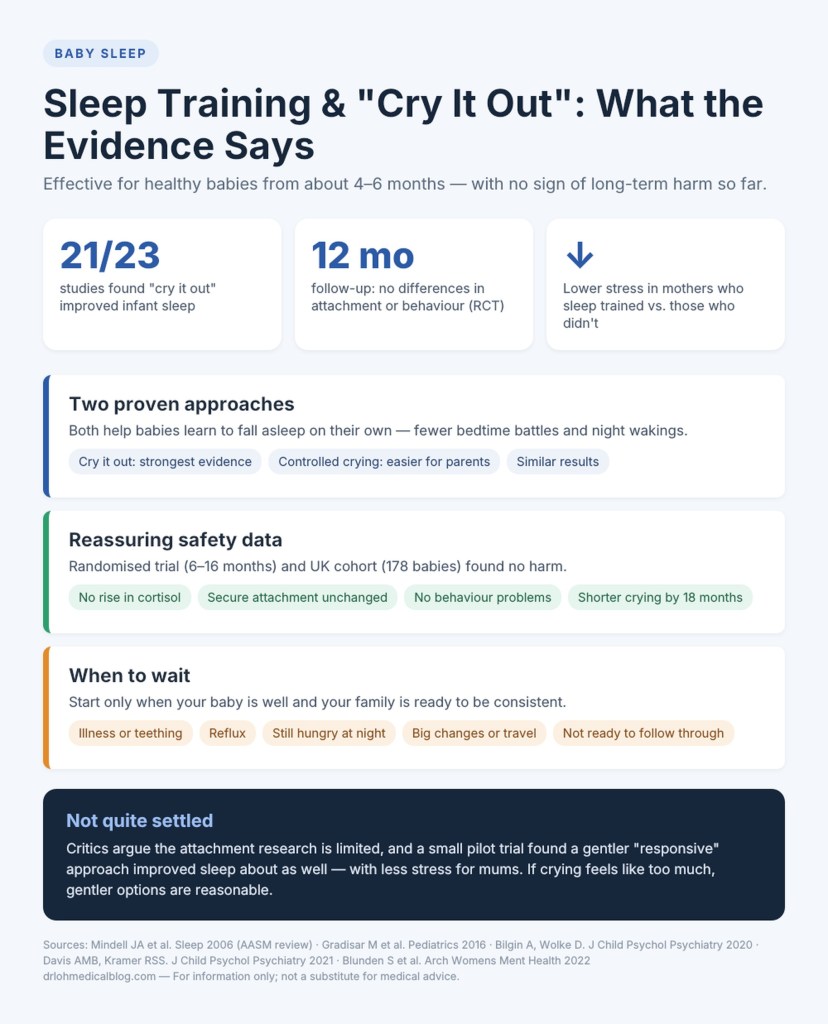
- “Cry it out” (unmodified extinction): Put your baby to bed at a set time and don’t respond to crying until morning, apart from checking for safety or illness. It has the strongest evidence — 21 of 23 studies showed benefit — but many parents find it hard to stick with.
- Graduated extinction (“controlled crying”): Let your baby cry for set, gradually longer intervals, with brief check-ins in between. The evidence is a little less robust, but parents find it much easier to follow — and it works about as well.
Does It Harm Attachment or Cause Stress?
This is the question most parents worry about. So far, the evidence is reassuring:
- No rise in stress hormones: In a randomised trial of 43 babies aged 6–16 months, those who were sleep trained showed no increase in the stress hormone cortisol.
- No long-term effects: One year later, there were no differences in emotional or behavioural problems, or in how securely the children were attached to their mothers.
- Less stress for parents: Mothers in the sleep-training groups actually reported less stress than those who didn’t sleep train.
- Similar findings at 18 months: A UK study of 178 babies found that occasionally or often leaving a baby to cry in the first 6 months was not linked to attachment or behaviour problems at 18 months — and these babies actually cried for shorter periods later on.
That said, the debate isn’t fully settled. Researchers have questioned whether the UK study was large enough to detect subtle effects on attachment, and cautioned against treating one study as the final word. A small pilot trial also found that a gentler, more “responsive” approach improved sleep about as well as controlled crying, with less stress and fewer low-mood symptoms in mothers.
When to Wait — and When It’s a Good Fit
Sleep training may suit your family if:
- Your baby is healthy, around 4–6 months or older, and feeding well during the day
- Broken sleep is taking a real toll on your family
- You (and your partner) are ready to follow through consistently
Hold off if your baby is unwell, teething, has reflux, or may still be waking from hunger — or if your family is going through a big change such as a move, a new caregiver, or travel. Being inconsistent can make crying at bedtime worse and drag it out longer, so only start when you’re ready to see it through.
The Bottom Line
For healthy babies from around 4–6 months, sleep training is an effective and, based on current evidence, safe way to improve sleep for the whole family. Graduated approaches are often easier for parents — and if crying feels like too much, gentler responsive methods are a reasonable alternative.
References
- Mindell JA et al. Behavioral Treatment of Bedtime Problems and Night Wakings in Infants and Young Children. Sleep. 2006;29(10):1263-1276.
- Gradisar M et al. Behavioral Interventions for Infant Sleep Problems: A Randomized Controlled Trial. Pediatrics. 2016;137(6):e20151486.
- Bilgin A et al. Parental Use of ‘Cry It Out’ in Infants: No Adverse Effects on Attachment and Behavioural Development at 18 Months. J Child Psychol Psychiatry. 2020;61(11):1184-1193.
- Davis AMB et al. Commentary: Does ‘Cry It Out’ Really Have No Adverse Effects on Attachment? Reflections on Bilgin and Wolke (2020). J Child Psychol Psychiatry. 2021;62(12):1488-1490.
- Blunden S et al. Do Responsive Sleep Interventions Impact Mental Health in Mother/Infant Dyads Compared to Extinction Interventions? A Pilot Study. Arch Womens Ment Health. 2022;25(3):621-631.



Leave a Reply