

Do you really need a vitamin D supplement, or a blood test to check your level?
Vitamin D is one of the most commonly tested and supplemented nutrients in adults. A recent review in American Family Physician pulls together the current evidence, and the picture is more nuanced than the supplement aisle suggests. This post is an update to the article, Do You Need Vitamin D Supplements?, with the newer guidance.
What Changed in the Guidelines
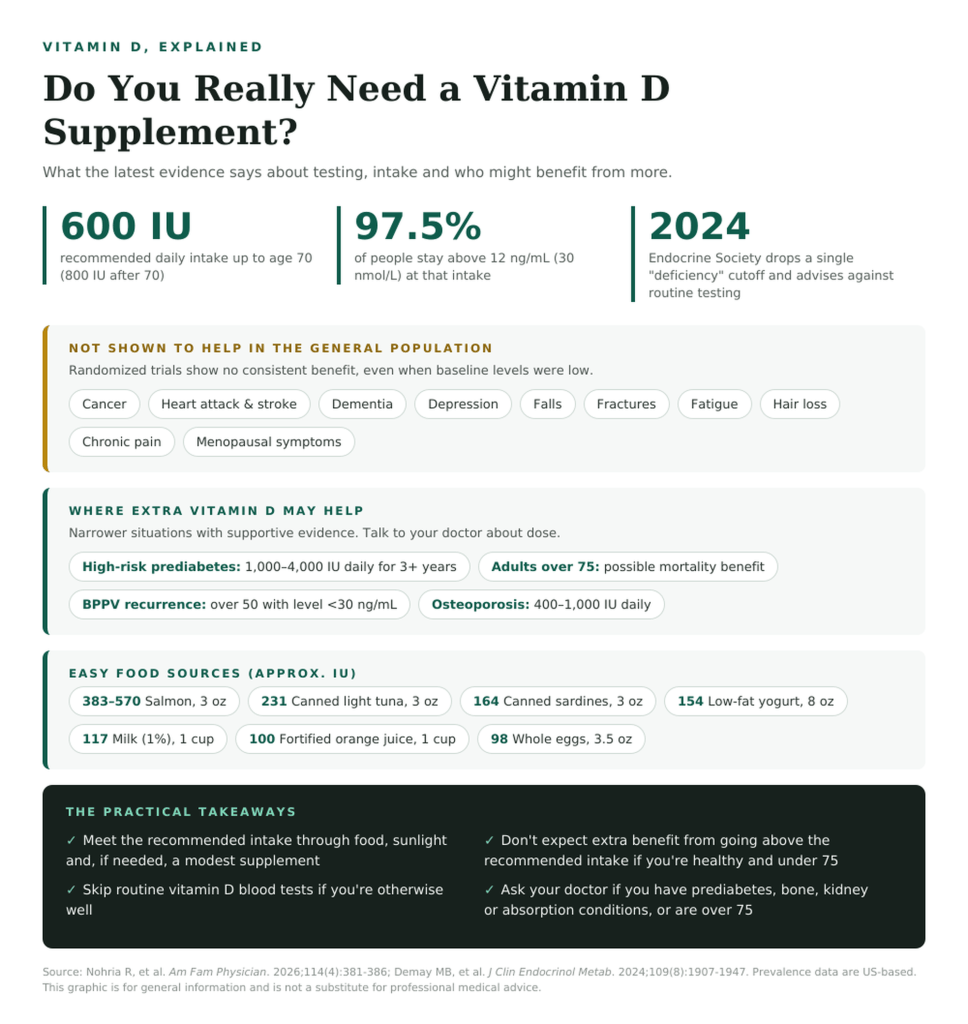
For years, guidelines suggested keeping your blood level at 30 ng/mL (75 nmol/L) or higher. In 2024, the Endocrine Society stopped defining “deficiency” by a single cutoff, because there is no consistent evidence that supplementing to reach a particular number improves health outcomes. It is also still unclear whether low levels cause disease or are simply a consequence of it.
How Much Do You Need?
The National Academy of Medicine recommends 600 IU (15 mcg) a day for adults aged 70 and younger, and 800 IU (20 mcg) a day for those older than 70. You can get this from food, supplements, or both. A few common food sources:
- Salmon, 3 oz: about 383–570 IU
- Canned light tuna, 3 oz: about 231 IU
- Canned sardines, 3 oz: about 164 IU
- Low-fat plain yogurt, 8 oz: about 154 IU
- Milk (1%), 1 cup: about 117 IU
- Fortified orange juice, 1 cup: about 100 IU
- Whole eggs, 3.5 oz: about 98 IU
Mackerel and fortified cereals are other common sources.
Sunlight on your skin also contributes, but sunbathing or using tanning beds is not a good way to get vitamin D, because of the risk of sunburn and skin cancer. Everyday, incidental sun counts for something; deliberately seeking it out for vitamin D isn’t worth the risk.
Should You Get Tested?
For most otherwise well adults, no. The Endocrine Society recommends against routine screening in the general population, and the US Preventive Services Task Force says the evidence is insufficient to judge the balance of benefits and harms. The Endocrine Society also found no consistent benefit from routine testing in people with obesity, darker skin tone, or age over 70.
What Vitamin D Does, and Doesn’t, Do
Vitamin D’s role in bone health is well established, and it prevents and treats rickets and osteomalacia. Severe deficiency can leave bones soft and muscles weak, but that doesn’t mean extra vitamin D protects people who aren’t deficient.
Beyond the bones, randomized trials in the general population haven’t shown consistent benefit from supplements:
- Overall mortality in the general population
- Cancer risk
- Cardiovascular disease (heart attack, stroke)
- Falls and fractures
- Dementia
- Depression
- Fatigue
- Hair loss
- Chronic pain
- Menopausal hot flashes and mood symptoms
Where Extra Vitamin D May Help
A few narrower situations do have supportive evidence:
- High-risk prediabetes: At least 3 years of 1,000–4,000 IU (25–100 mcg) daily has been shown to reduce progression to type 2 diabetes, alongside lifestyle change.
- Adults over 75: The Endocrine Society suggests supplementation may reduce all-cause mortality, based on about 6 fewer deaths per 1,000 older adults taking an average of 900 IU daily for 2 years.
- Benign paroxysmal positional vertigo (BPPV): In adults over 50 with a level below 30 ng/mL (75 nmol/L), supplements may reduce the chance of the vertigo coming back over the following year.
- Osteoporosis: Guidelines recommend 400–1,000 IU (10–25 mcg) daily, based on expert opinion.
If you fall into one of these groups, agree the type and dose with your doctor rather than choosing your own. Taking too much vitamin D can make you sick.
The Bottom Line
For most healthy adults, meeting the recommended intake through food, sunlight and, if needed, a modest supplement is enough. Routine blood tests and high-dose supplements haven’t been shown to improve outcomes, though a few groups (prediabetes, older age, certain bone and medical conditions) may be exceptions worth discussing with your doctor.
References
- Nohria R, Bagatelas P, Martin S. Vitamin D supplementation in community-dwelling adults. Am Fam Physician. 2026;114(4):381-386.
- Demay MB, Pittas AG, Bikle DD, et al. Vitamin D for the prevention of disease: an Endocrine Society clinical practice guideline. J Clin Endocrinol Metab. 2024;109(8):1907-1947.
- Krist AH, Davidson KW, Mangione CM, et al. Screening for vitamin D deficiency in adults: US Preventive Services Task Force recommendation statement. JAMA. 2021;325(14):1436-1442.
- Cashman KD, Kiely ME, Andersen R, et al. Individual participant data (IPD)-level meta-analysis of randomised controlled trials with vitamin D-fortified foods to estimate dietary reference values for vitamin D. Eur J Nutr. 2021;60(2):939-959.
- Manson JE, Cook NR, Lee IM, et al. Vitamin D supplements and prevention of cancer and cardiovascular disease. N Engl J Med. 2019;380(1):33-44.
- Bouillon R, Manousaki D, Rosen C, et al. The health effects of vitamin D supplementation: evidence from human studies. Nat Rev Endocrinol. 2022;18(2):96-110.
- Pittas AG, Kawahara T, Jorde R, et al. Vitamin D and risk for type 2 diabetes in people with prediabetes: a systematic review and meta-analysis of individual participant data from 3 randomized clinical trials. Ann Intern Med. 2023;176(3):355-363.
- De Chua KW, Huang X, Koh XH, et al. Randomized controlled trial assessing vitamin D’s role in reducing BPPV recurrence in older adults. Otolaryngol Head Neck Surg. 2025;172(1):127-136.





Leave a Reply