

Does teething cause fever? Not true fever, according to the evidence.
What happens to temperature?
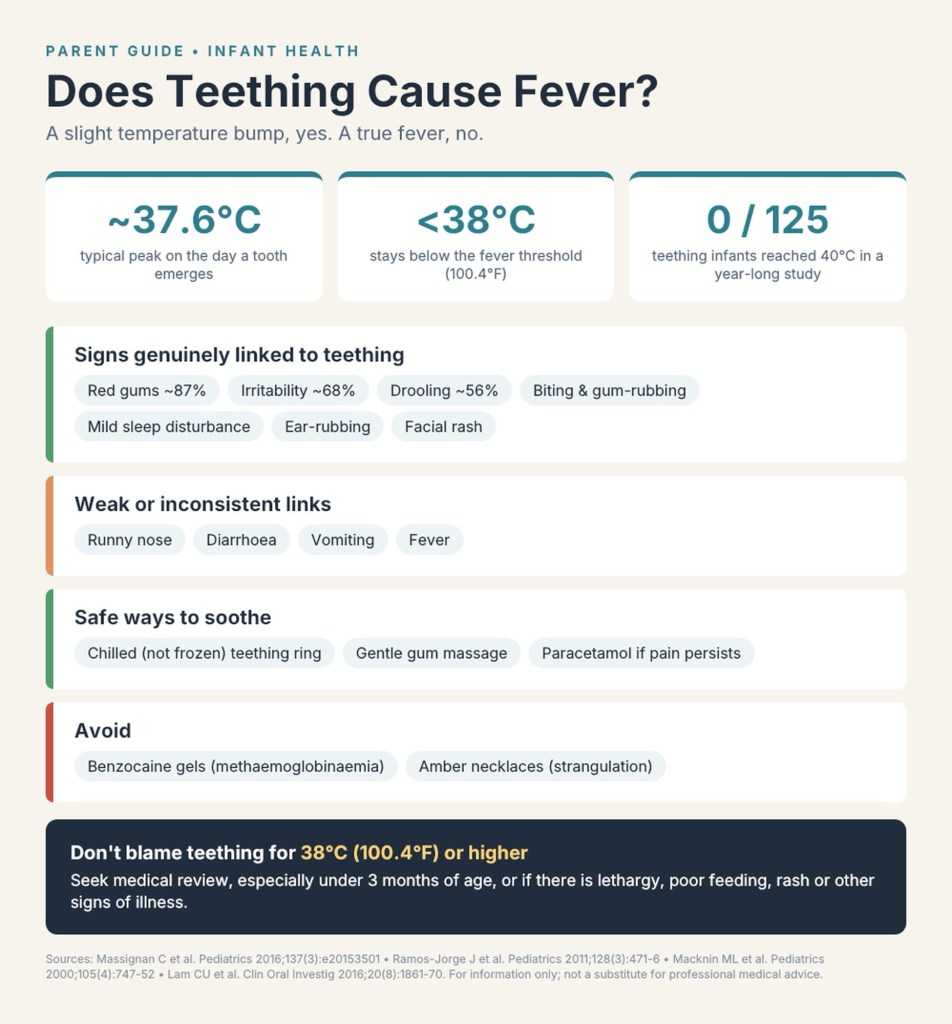
Teething can nudge body temperature up slightly. In one prospective study, average tympanic temperature rose from about 36.9–37.1°C to about 37.6°C on the day a tooth emerged. That is still below the usual fever threshold of 38°C (100.4°F).
- A study of 125 infants followed for a year found none of the teething babies reached 40°C (104°F).
- Fever above 38.9°C (102°F) was not significantly linked to tooth emergence.
- A meta-analysis of over 3,500 children agreed: a slight rise, but not fever.
What teething does cause
The signs most reliably linked to teething are local and behavioural:
- Red, irritated gums (~87%)
- Irritability (~68%)
- Drooling (~56%)
- More biting, gum-rubbing and sucking
- Mild sleep disturbance, ear-rubbing, facial rash, less appetite for solids
A runny nose, diarrhoea and vomiting show up less consistently, and the link to teething is much weaker. Fever sits well down the list.
When it’s not teething
Don’t blame teething for a temperature of 38°C (100.4°F) or higher. Seek medical review promptly, especially if:
- Your baby is under 3 months old (any fever of 38°C or above)
- There is lethargy, poor feeding, a rash, or other signs of illness
Easing teething discomfort
- Chilled (not frozen) teething rings
- Gentle gum massage
- Paracetamol (acetaminophen) if pain persists
- Avoid benzocaine gels (risk of methaemoglobinaemia) and amber teething necklaces (strangulation risk)
The Bottom Line
Teething may cause a mild temperature bump and sore, drooly gums, but not a true fever. If your baby has one, look for another cause.
Related: For Parents
References
- Massignan C, et al. Signs and Symptoms of Primary Tooth Eruption: A Meta-Analysis. Pediatrics. 2016;137(3):e20153501.
- Ramos-Jorge J, et al. Prospective Longitudinal Study of Signs and Symptoms Associated With Primary Tooth Eruption. Pediatrics. 2011;128(3):471-6.
- Macknin ML, et al. Symptoms Associated With Infant Teething: A Prospective Study. Pediatrics. 2000;105(4 Pt 1):747-52.
- Lam CU, et al. Early-Life Factors Affect Risk of Pain and Fever in Infants During Teething Periods. Clin Oral Investig. 2016;20(8):1861-70.
- Sarvas E, et al. Oral Health Care for Children and Youth With Developmental Disabilities. Pediatrics. 2024;154(2):e2024067603.





Leave a Reply