

If you’re caring for a family member, how do you know when ordinary tiredness has tipped into something that needs attention?
Why Screen for Caregiver Burden at All
Caregiver burden is the physical, emotional, and financial strain that builds up when you’re responsible for someone else’s day-to-day care — whether that’s a parent with dementia, a spouse recovering from a stroke, or a child with a chronic condition. It doesn’t always announce itself. Many caregivers simply adjust, quietly, until sleep, health, or relationships start to slip.
The good news is that you don’t need a clinic visit to get a first read on where you stand. Several brief, self-administered questionnaires have been validated specifically for this purpose, and two of them are widely regarded as the most useful starting points: the Zarit Burden Interview (ZBI) and the Burden Scale for Family Caregivers — short version (BSFC-s). Both take only a few minutes, both have been tested across many caregiving situations and languages, and both are free to download and score yourself right now.
The Zarit Burden Interview (ZBI)
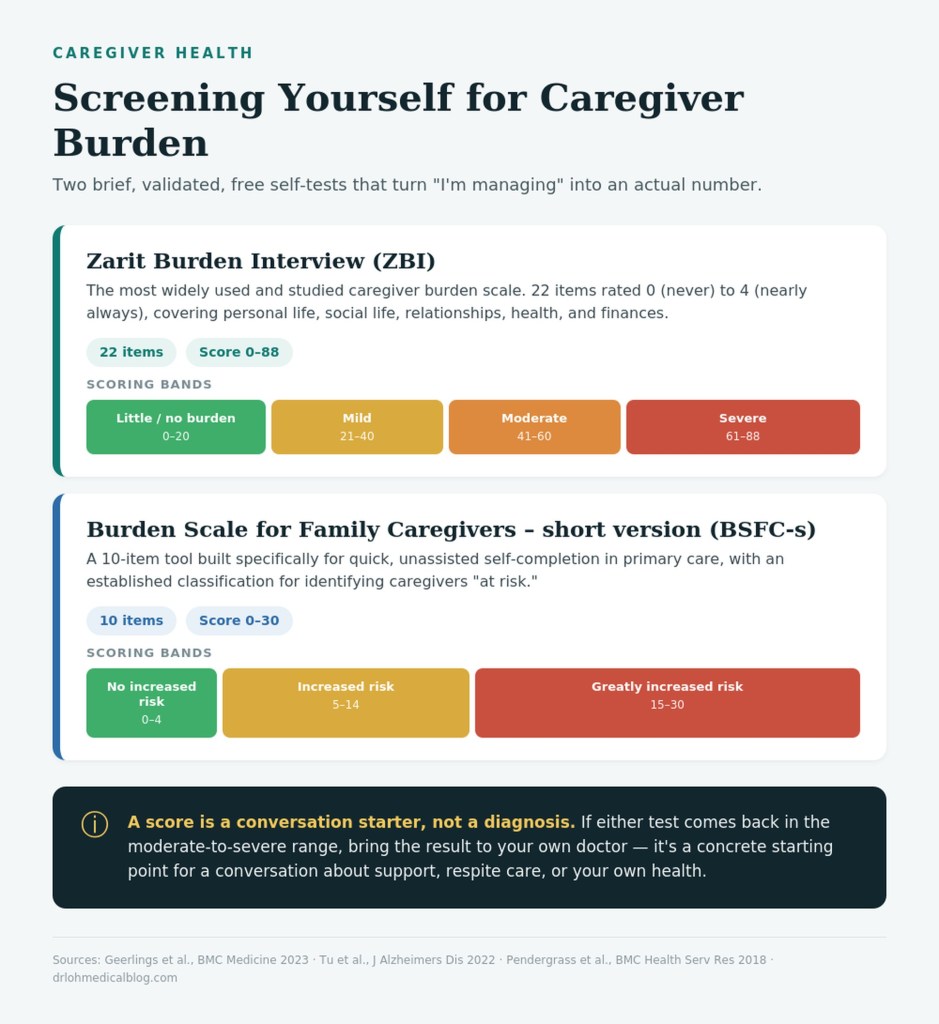
The ZBI is the most widely used and studied caregiver burden questionnaire in the research literature. The original version has 22 statements — things like “Do you feel stressed between caring for your family member and trying to meet other responsibilities?” — each rated on a 5-point scale from 0 (never) to 4 (nearly always). The points add up to a total score of 0 to 88, covering how caregiving is affecting your personal life, social life, relationships, health, and finances.
Commonly used cutoffs are:
- Little or no burden (under 21)
- Mild burden (21–40)
- Moderate burden (41–60)
- Severe burden (over 60)
Some studies use slightly different bands. The ZBI has strong internal consistency and has been validated across many languages and caregiving populations, including dementia, Parkinson’s disease, cancer, and palliative care.
You can download the full questionnaire — including the exact wording of every item and the scoring instructions — for free, with no sign-up required:
→ Download the Zarit Burden Interview and scoring guide (PDF)
Add up your answers (0 to 4 on each of the 22 items) and compare the total against the bands above — it takes most people under five minutes.
The Burden Scale for Family Caregivers — Short Version (BSFC-s)
The BSFC-s takes a different approach: it’s a 10-item screening tool, rated on a 4-point scale, purpose-built for quick administration in primary care or counselling settings. It was specifically designed so caregivers could complete it themselves, without assistance, and it comes with an established classification system for identifying who is “at risk.”
Scores run from 0 to 30, with three bands:
- 0–4 (no increased risk of physical complaints or depression)
- 5–14 (increased risk of physical complaints, but not yet depression)
- 15–30 (greatly increased risk of both physical complaints and depression).
You can download the full 10-item questionnaire for free, with no sign-up required:
→ Download the BSFC-s questionnaire (PDF)
Each item is rated strongly agree (3) to strongly disagree (0); add up all 10 and check your total against the bands above.
The Bottom Line
Neither test replaces a proper medical assessment, but both give you something concrete: a number, and a band, instead of a vague feeling that you’re “managing.” If your score on either the ZBI or the BSFC-s comes back in the moderate-to-severe range, that’s worth bringing to your own doctor — not as a diagnosis, but as a starting point for a real conversation about support, respite care, or your own health.
References
- Geerlings AD, Kapelle WM, Sederel CJ, et al. Caregiver burden in Parkinson’s disease: a mixed-methods study. BMC Medicine. 2023;21(1):247.
- Tu JY, Jin G, Chen JH, Chen YC. Caregiver Burden and Dementia: A Systematic Review of Self-Report Instruments. J Alzheimers Dis. 2022;86(4):1527-1543.
- Qi H, Ban J, Wang N, et al. Factors influencing the caregiver burden for family caregivers of people with moderate-to-severe dementia: A structural equation modeling analysis. PLoS One. 2026;21(2):e0341719.
- Tay LX, Ong SC, Ong HM, et al. Caregiver burden of Alzheimer’s disease among informal caregivers: a cross-sectional study in Malaysia. Sci Rep. 2025;15(1):10067.
- Summart U, Kaewbubpha T, Saengnil O, et al. Psychometric validation of the Thai version of the 12-item Zarit Burden Interview among informal caregivers in a palliative care setting in the south of Thailand. PLoS One. 2025;20(5):e0322852.
- Pendergrass A, Malnis C, Graf U, Engel S, Graessel E. Screening for caregivers at risk: Extended validation of the short version of the Burden Scale for Family Caregivers (BSFC-s) with a valid classification system for caregivers caring for an older person at home. BMC Health Serv Res. 2018;18(1):229.





Leave a comment