

The Delayed Food Allergy Doctors Often Miss in Babies
Why FPIES Doesn’t Look Like a “Normal” Food Allergy
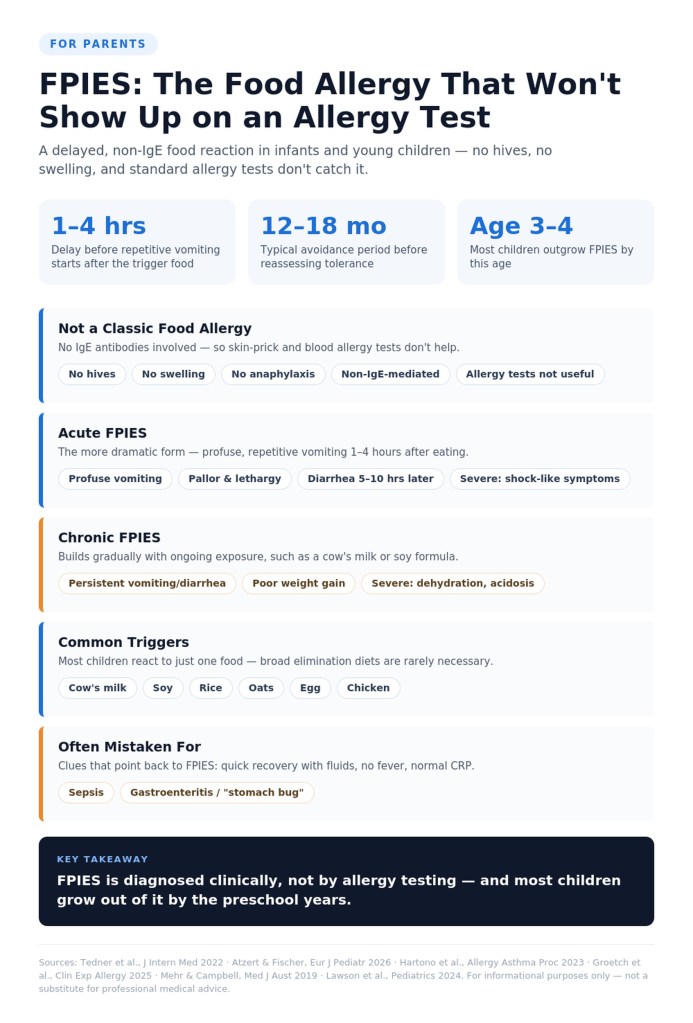
Food protein-induced enterocolitis syndrome (FPIES) is a food allergy that mainly affects infants and young children, but it works nothing like the food allergies most people picture.
Classic food allergies are IgE-mediated — they involve antibodies that trigger hives, swelling, or anaphylaxis within minutes.
FPIES is non-IgE-mediated: there’s no hives, no swelling, no anaphylaxis, and the reaction is delayed rather than immediate.
What an FPIES Episode Actually Looks Like
FPIES shows up in a few different patterns:
- Acute FPIES — the more dramatic form. Profuse, repetitive vomiting starts 1 to 4 hours after eating the trigger food, often with pallor and lethargy. In severe cases, children can progress to low blood pressure and low body temperature, with diarrhea sometimes following 5 to 10 hours later.
- Chronic FPIES — happens with ongoing exposure, such as a cow’s milk or soy-based formula. Instead of one dramatic episode, it builds gradually: persistent vomiting and diarrhea, poor weight gain, and in severe cases, dehydration and metabolic acidosis.
Most children with FPIES react to only one trigger food. This matters practically — a single bad reaction doesn’t mean a long list of foods needs to be cut out.
Common Triggers
Cow’s milk, soy, rice, and oats are among the most frequently reported triggers, though other grains can cause it too. (In Australia, the leading triggers reported are rice, cow’s milk, egg, oats, and chicken — the exact list varies somewhat by region and diet.)
Why It’s So Often Missed
Because acute FPIES can involve vomiting, pallor and lethargy, it’s frequently mistaken for a stomach bug in the emergency room. A few clues tend to point toward FPIES instead: the child recovers quickly once fluids are given, there’s no fever, and blood markers of infection (like CRP) stay essentially normal.
How It’s Diagnosed
FPIES is diagnosed clinically, based on international consensus criteria, rather than through a blood or skin test. The core pattern doctors look for is repetitive vomiting 1 to 4 hours after eating a food, without the classic signs of an IgE-mediated allergy, along with a cluster of supporting features — things like a repeat episode after the same or another food, marked lethargy or pallor, needing emergency care or IV fluids, diarrhea within a day, or drops in blood pressure or temperature.
Where there’s genuine doubt, a supervised oral food challenge — reintroducing the food under medical observation — can confirm it, though this is often unnecessary if the clinical picture is already clear. It’s used more commonly later on, to check whether a child has outgrown their FPIES.
Managing FPIES — and the Good News
Management is straightforward in principle: avoid the identified trigger food, typically for 12 to 18 months from the last reaction, then reassess tolerance with a supervised food challenge. Acute reactions involving severe dehydration need emergency fluid resuscitation, so any suspected severe episode should be treated as urgent.
The genuinely good news: most children outgrow FPIES by age 3 to 4. For parents navigating the early months of introducing new foods, that’s a meaningful light at the end of the tunnel.
The Bottom Line
FPIES is a delayed, non-IgE food reaction that doesn’t show up on allergy tests and is easy to mistake for a stomach bug — but it’s diagnosed clinically, usually involves just one trigger food, and most children grow out of it by the preschool years.
Related: What Should I Know About Baby Food Allergy?, How to Spot and Prevent Dehydration in Your Kids
References
- Tedner SG, Asarnoj A, Thulin H, et al. Food allergy and hypersensitivity reactions in children and adults—A review. J Intern Med. 2022;291(3):283-302.
- Atzert N, Fischer I. Acute food protein–induced enterocolitis syndrome in Switzerland: a 10-year retrospective review. Eur J Pediatr. 2026;185(4):199.
- Hartono S, Zidan E, Sitaula P, Brooks JP. Pearls and Pitfalls in Food Protein-Induced Enterocolitis Syndrome (FPIES). Allergy Asthma Proc. 2023;44(5):368-373.
- Groetch M, Venter C, Meyer R. Clinical Presentation and Nutrition Management of Non-IgE-Mediated Food Allergy in Children. Clin Exp Allergy. 2025;55(3):213-225.
- Mehr S, Campbell DE. Food Protein-Induced Enterocolitis Syndrome: Guidelines Summary and Practice Recommendations. Med J Aust. 2019;210(2):94-99.
- Lawson NR, Angelo J, Chiou E, Glinton K, Dean A. Failure to Thrive, Metabolic Acidosis, and Diarrhea in a 7-Week-Old Infant. Pediatrics. 2024;154(3):e2023064240.




Leave a comment