

Is jumping actually good for you?
Jump rope. Box jumps. Hopscotch with your kids. Jumping is one of the simplest movements in human motion — and it turns out to be one of the more evidence-backed forms of exercise for bone health, cardiovascular fitness, and athletic performance. Here’s what a growing body of systematic reviews and clinical trials tells us.
Bone Health: Building Density with Every Landing
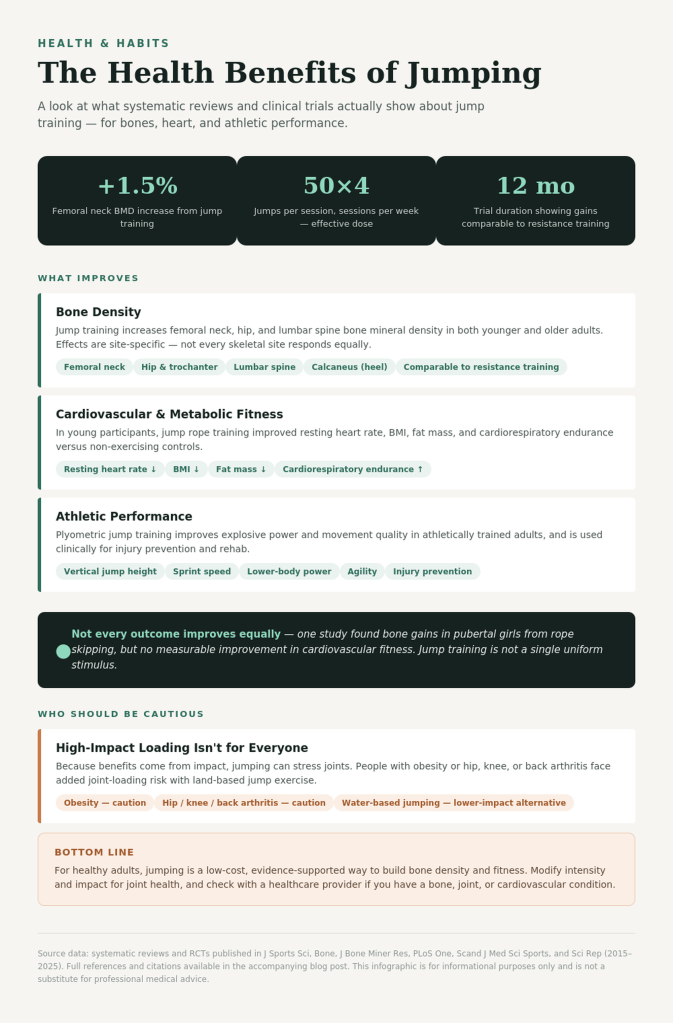
Jumping is a form of high-impact, weight-bearing exercise, and bone responds to impact by getting stronger. A systematic review and meta-analysis found jump training produced a small-to-moderate increase in femoral neck bone mineral density (BMD) of roughly 1.5%, with benefits observed in both younger and older adults. The “median” effective dose landed around 50 jumps, four times a week.
Read: Are Your Bones Strong? The Essential Guide to Osteoporosis Screening & Prevention, Live Long & Healthy #9 – How DEXA Scans Can Transform Your Health Journey
Heart and Metabolic Fitness
Beyond bone, jump rope training has cardiometabolic benefits, particularly in younger populations. A meta-analysis of jump rope programs in young participants found improvements in resting heart rate, BMI, fat mass, and cardiorespiratory endurance compared with non-exercising controls.
Read: Live Long & Healthy #15 – How Your Resting Heart Rate Can Influence Longevity, Know Your Numbers: Mastering BMI and Waist Circumference for Better Health, Live Long & Healthy #4 – The VO2 Max-Longevity Connection!
Athletic Performance and Injury Prevention
For people already engaged in structured training, plyometric (explosive) jump training has some of the strongest evidence behind it. Studies and meta-analyses in athletically trained adults show improvements in:
- Vertical jump height
- Sprint speed
- Lower-body strength and power
- Agility
- Body fat percentage
Plyometric training is also used clinically in injury prevention and rehabilitation programs, and to help counteract the loss of muscle power that comes with aging or extended periods of inactivity.
Who Should Be Cautious
Jumping isn’t risk-free for everyone. Its benefits come specifically from impact loading — which is also what makes it a concern for certain groups. High-impact jumping may not be appropriate for people with obesity or with arthritis of the hip, knee, or back, due to the joint loading involved. For these populations, water-based jump exercise has been studied as a lower-impact alternative that may preserve some of the bone-health benefit while reducing joint stress.
The Bottom Line
For most healthy individuals, jumping is a safe, low-cost, and genuinely effective way to support bone density, cardiorespiratory fitness, and musculoskeletal performance — with a dose as modest as a few sets of jumps several times a week showing measurable results. As with any exercise program, especially one involving repetitive impact, it’s worth tailoring intensity and frequency to your own joint health and fitness level, and consulting a healthcare provider if you have a bone, joint, or cardiovascular condition.
References
- Florence GE, Oosthuyse T, Bosch AN. Skeletal Site-Specific Effects of Jump Training on Bone Mineral Density in Adults: A Systematic Review and Meta-Analysis. J Sports Sci. 2023;41(23):2063-2076.
- Ha AS, Ng JYY. Rope Skipping Increases Bone Mineral Density at Calcanei of Pubertal Girls in Hong Kong: A Quasi-Experimental Investigation. PLoS One. 2017;12(12):e0189085.
- Hinton PS, Nigh P, Thyfault J. Effectiveness of Resistance Training or Jumping-Exercise to Increase Bone Mineral Density in Men With Low Bone Mass: A 12-Month Randomized, Clinical Trial. Bone. 2015;79:203-212.
- Ng CA, Gandham A, Mesinovic J, et al. Effects of Moderate- to High-Impact Exercise Training on Bone Structure Across the Lifespan: A Systematic Review and Meta-Analysis of Randomized Controlled Trials. J Bone Miner Res. 2023;38(11):1612-1634.
- Singh U, Ramachandran AK, Ramirez-Campillo R, et al. Jump Rope Training Effects on Health- and Sport-Related Physical Fitness in Young Participants: A Systematic Review With Meta-Analysis. J Sports Sci. 2022;40(16):1801-1814.
- Ramirez-Campillo R, Moran J, Chaabene H, et al. Methodological Characteristics and Future Directions for Plyometric Jump Training Research: A Scoping Review Update. Scand J Med Sci Sports. 2020;30(6):983-997.
- Oxfeldt M, Overgaard K, Hvid LG, Dalgas U. Effects of Plyometric Training on Jumping, Sprint Performance, and Lower Body Muscle Strength in Healthy Adults: A Systematic Review and Meta-Analyses. Scand J Med Sci Sports. 2019;29(10):1453-1465.
- Sun J, Sun J, Shaharudin S, Zhang Q. Effects of Plyometrics Training on Lower Limb Strength, Power, Agility, and Body Composition in Athletically Trained Adults: Systematic Review and Meta-Analysis. Sci Rep. 2025;15(1):34146.
- Chien KY, Chang WG, Sanders ME, et al. Effects of Land vs Water Jump Exercise: Implications for Exercise Design Targeting Bone Health. Scand J Med Sci Sports. 2019;29(6):826-834.





Leave a Reply