
Lifting Weights for Longevity? Here’s the Dose That Actually Matters
If you’ve ever wondered whether lifting weights twice a week is “enough,” a new 30-year study says: probably yes — and going far beyond that may not buy you much more.
Here’s what the science actually shows, and what it means for how you plan your workouts.
The Study
Researchers pooled data from three major long-running US studies — the Health Professionals Follow-up Study, the Nurses’ Health Study, and the Nurses’ Health Study II — tracking 31,540 men and 115,834 women. Over the follow-up period, 35,798 participants died. Because participants reported their exercise habits repeatedly over many years (rather than just once), the researchers could map out a detailed dose-response curve: how mortality risk changes as weekly resistance training minutes go up.
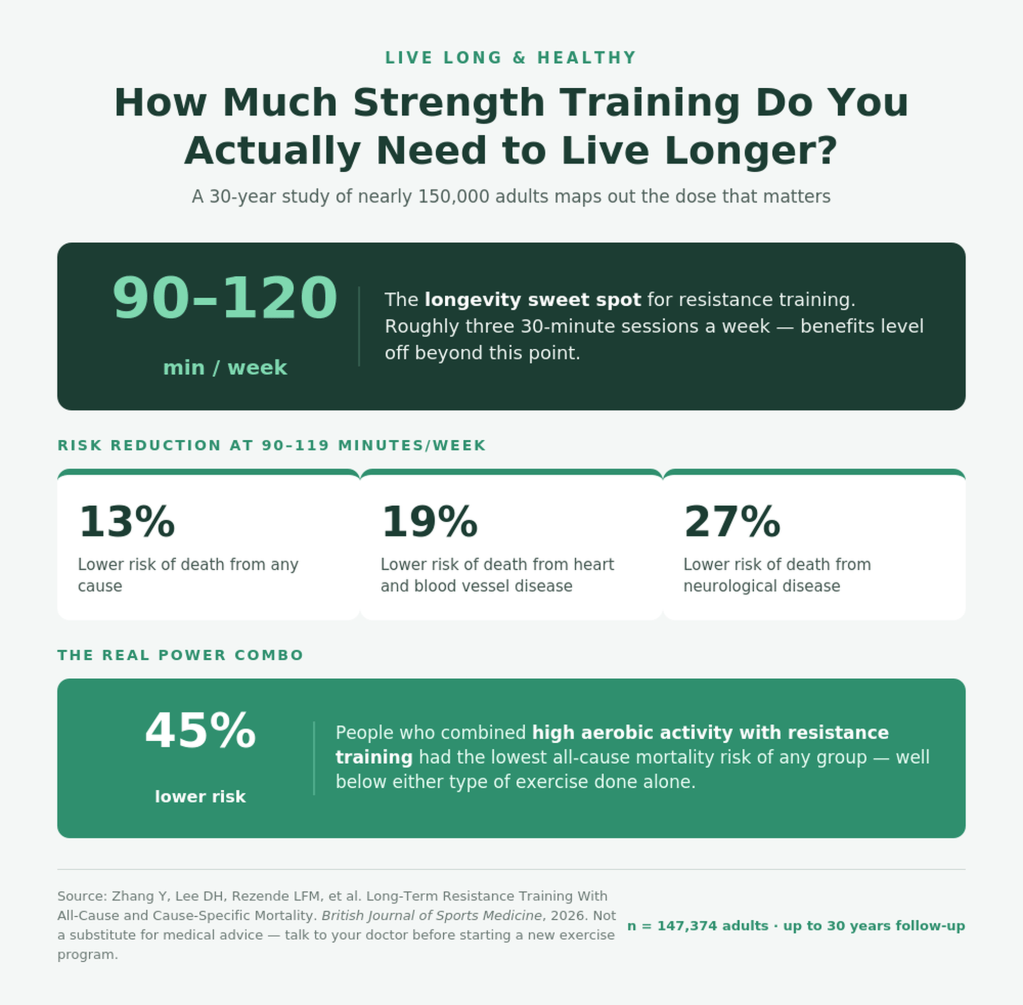
The Sweet Spot: 90–120 Minutes a Week
The most striking finding is that benefits from resistance training don’t keep climbing the more you do. They rise, then flatten out.
At 90 to 119 minutes of resistance training per week (roughly 15–20 minutes, five days a week, or three solid 30-minute sessions), people had:
- 13% lower risk of death from any cause
- 19% lower risk of death from cardiovascular disease
- 27% lower risk of death from neurological disease
Past 120 minutes per week, the curve plateaus — more resistance training wasn’t linked to any additional drop in mortality risk. In other words, once you’re in that 90–120 minute range, you appear to be capturing most of the longevity benefit resistance training has to offer.
Strength Training Plus Cardio Is the Real Power Combo
The study also looked at what happens when people combine resistance training with aerobic activity — and the results were the best of any group studied. People who did both high levels of aerobic exercise and resistance training had 45% lower all-cause mortality risk compared with those who did neither.
What This Means for Your Routine
Taken together, these findings point toward a few practical takeaways:
- You don’t need to be in the gym for hours. The mortality benefits of resistance training appear to max out around 90–120 minutes per week — about the time commitment of three moderate strength sessions.
- Consistency over intensity. Even small amounts of regular resistance training were linked to benefits, particularly for cancer mortality.
- Pair it with cardio if you can. The lowest mortality risk in this study belonged to people doing both aerobic and resistance training — not one or the other.
- More isn’t always better. Beyond the plateau point, additional resistance training minutes weren’t associated with extra longevity benefit, which is reassuring for anyone worried they’re not doing “enough.”
Related:
- Medical Myths or Facts #50: Resistance Training Edition
- Live Long & Healthy #20 – Strong Today, Stronger Tomorrow: The Longevity Benefits of Resistance Training
- Medical Myths or Facts #49: Does Strength Training Help Prevent Dementia?
- Live Long & Healthy #3 – The Surprising Connection Between Hand Strength and Longevity!
References:
- Zhang Y, Lee DH, Rezende LFM, Ma Y, Giovannucci E. Long-Term Resistance Training With All-Cause and Cause-Specific Mortality: Assessing Dose-Response and Joint Associations With Aerobic Physical Activity. Br J Sports Med. 2026.
- Saeidifard F, Medina-Inojosa JR, West CP, et al. The Association of Resistance Training With Mortality: A Systematic Review and Meta-Analysis. Eur J Prev Cardiol. 2019.
- López-Bueno R, Ahmadi M, Stamatakis E, Yang L, Del Pozo Cruz B. Prospective Associations of Different Combinations of Aerobic and Muscle-Strengthening Activity With All-Cause, Cardiovascular, and Cancer Mortality. JAMA Intern Med. 2023.
- Rahmati M, Lee H, Lee H, et al. Associations Between Exercise Training, Physical Activity, Sedentary Behaviour and Mortality: An Umbrella Review of Meta-Analyses. J Cachexia Sarcopenia Muscle. 2025.





Leave a comment