

The Surprising Winner in the Battle of Knee Osteoarthritis Exercises
If your knees ache when you climb stairs, get up from a chair, or take a walk around the block, you are far from alone. Knee osteoarthritis affects hundreds of millions of people worldwide, and one of the most common questions people ask their doctors is: what kind of exercise should I be doing?
What the Research Found
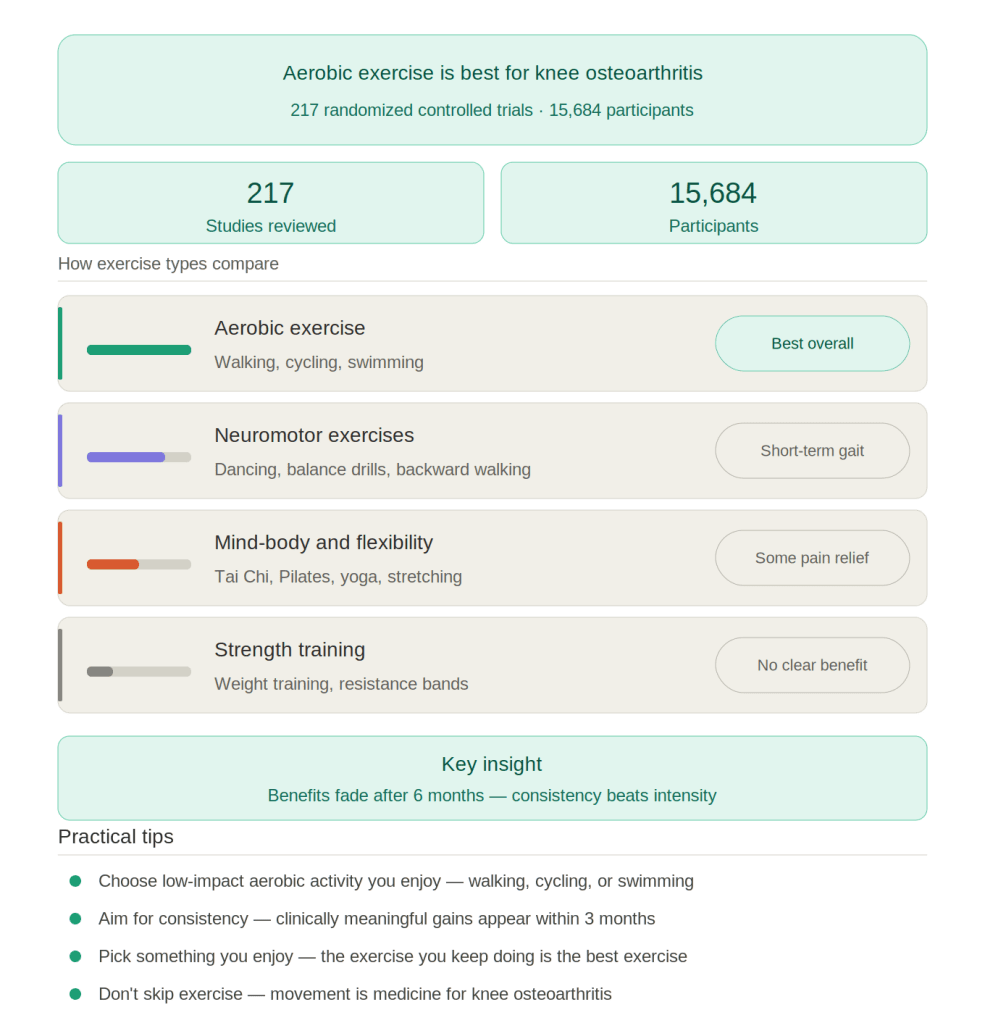
A major meta-analysis published in the BMJ pooled data from 217 randomized controlled trials involving 15,684 participants, all of whom had knee osteoarthritis. The researchers compared multiple types of exercise — aerobic exercise, strength training, mind-body practices like Tai Chi and Pilates, neuromotor exercises (think balance work, dancing, and walking backward), and flexibility training — to see which produced the best outcomes for pain relief, physical function, gait, and quality of life.
The verdict: aerobic exercise came out on top.
Aerobic exercise — walking, cycling, swimming, or any activity that gets your heart rate up steadily — produced clinically meaningful improvements in both pain and function within the first three months. It outperformed all other exercise types at moderate certainty of evidence.
What About the Other Types?
The picture for other modalities was more mixed:
- Neuromotor exercises (dancing, heel-to-toe walking, walking backward) showed meaningful improvements in gait in the short term, but the gains didn’t last.
- Mind-body exercises (Tai Chi, Pilates) and flexibility training reduced pain for some people in the short term.
- Strength training — perhaps the most commonly recommended approach — showed no marked or consistent benefit across the studies.
One important caveat across all modalities: the benefits were generally modest and tended to fade after about six months. This suggests that consistency matters enormously — the exercise you keep doing is ultimately better than the exercise you stop.
What This Means for You
If you have knee osteoarthritis, here are some practical takeaways:
- Start with low-impact aerobic activity. Walking, swimming, and stationary cycling are all excellent options that minimize stress on the joint while still delivering aerobic benefits.
- Aim for consistency over intensity. The research shows benefits in the first three months. Building a sustainable habit is more important than doing intense sessions.
- Find something you enjoy. The researchers noted that the average effect, while real, was not large — suggesting it works best for people who engage with it regularly and willingly.
- Don’t skip exercise because your knees hurt. Movement, done appropriately, is medicine for osteoarthritis. A physical therapist can help you find the right starting point if you’re unsure.
The Bottom Line
For knee osteoarthritis, aerobic exercise is currently the best evidence-based exercise option for reducing pain and improving function. It won’t work the same way for everyone, and no exercise is a cure — but the data clearly favor getting moving over staying still. Lace up your shoes, hop on a bike, or head to the pool. Your knees will thank you.
Related: Medical Myths or Facts #52: Do Knee Braces Work For Knee Osteoarthritis?, Medical Myths or Facts #33: Do Hyaluronic Acid Injections for Knee Osteoarthritis Help Delay Knee Replacement Surgery?
Reference: Yan L, Li D, Xing D, et al. Comparative efficacy and safety of exercise modalities in knee osteoarthritis: systematic review and network meta-analysis. BMJ. 2025.





Leave a Reply