
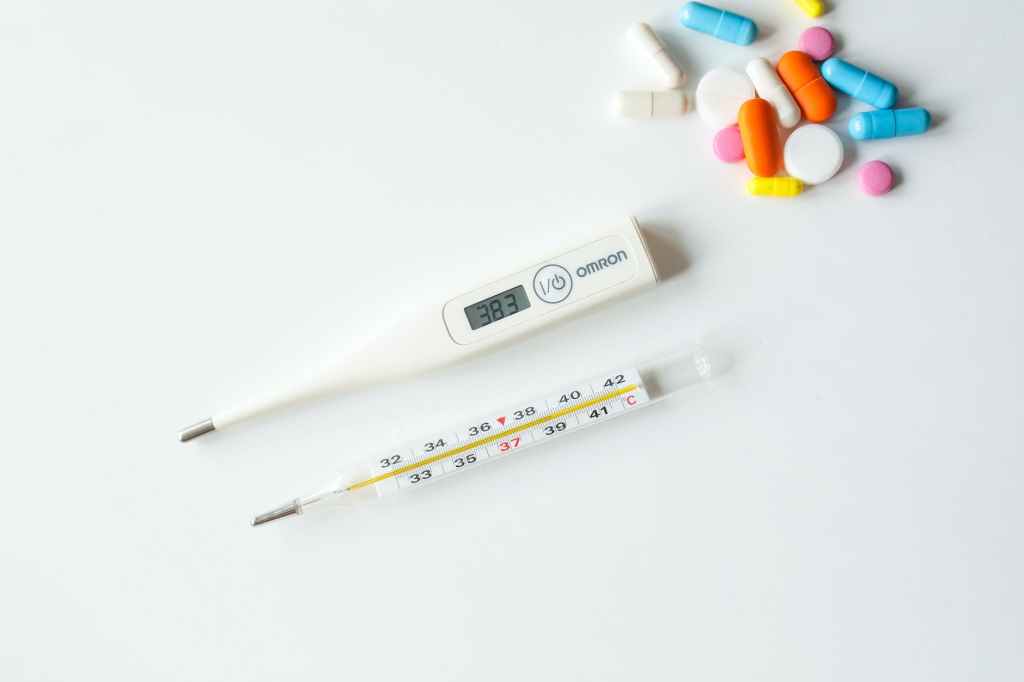
In my practice, I realize that one common misconception that parents have surrounding fever is the belief that it is an illness in itself rather than a symptom of an underlying condition.
It is often misunderstood as a harmful entity, leading some parents to immediately resort to fever-reducing medications without consulting a healthcare provider to address the root cause of the elevated temperature.
It’s important to recognize that fever alone does not always indicate a severe illness, and it is crucial to consider other symptoms and seek professional medical advice for a comprehensive evaluation and appropriate treatment.
Definitions of fever:
- Rectal temperature is above 38 deg C (Most accurate).
- Ear temperature is above 37.8 deg C.
- Oral temperature is above 37.5 deg C.
- Underarm temperature is above 37.3 deg C.
- NOTE: It is not accurate to gauge the child’s temperature by feeling the skin of the child.
General guidance points for parents:
- Fever is not an illness but a response of the body’s immune system to infections, inflammation, or other medical conditions. It serves a crucial role in the body’s defense mechanism, as it helps to create an environment less conducive to the growth of viruses/bacteria and stimulates the immune system.
- In otherwise healthy children, most fevers are self-limited and benign, provided that the cause is known and fluid loss is replaced; fever does not cause brain damage.
- There is no evidence that fever makes the illness worse.
- Initial measures to reduce the child’s temperature include provision of extra fluids and reduced activity.
- Fever may merit treatment with a temperature-lowering medication if the child is uncomfortable (as indicated by decreased activity level, decreased fluid intake, etc).
- Decreased temperature after receiving a medication does not help to determine whether the child has a bacterial or viral infection.
- Children who are receiving treatment for fever do not need to be awakened to receive the medication.
- Temperature-lowering medication should be dosed according to weight, rather than age. Hence, it is important to consult a doctor first to get the correct dosage.
- Do not use ice or cold water to try to bring down the child’s temperature. That may cause chills or shivering, further raising the baby’s temperature.
- Do not bundle up the child with more blankets as that would only trap more body heat, causing the body temperature to stay high.
Go to the Children’s Emergency immediately if your child:
- Has a temperature of more than 41.0°C, or 38.0°C for those less than 3 months old
- Is difficult to awaken. Fever may make children sleep more but they should awaken easily and be able to respond to you
- Seems confused or delirious
- Cries constantly and you cannot settle him or her
- Has difficulty breathing
- Is very lethargic
- Has a skin colour that appears pale or grey
- Has bruising spots
- Has a fit (seizure or convulsion)
- Is drinking less fluids and has significantly less urine output than usual
Useful Materials for Parents:
- Fever Diary: https://www.kkh.com.sg/sites/shcommonassets/Assets/conditions-treatments/images/kkh/fever-in-children-kkh.pdf
Related Articles:
- Medical Myths or Facts #10 – Combining Paracetamol and Ibuprofen for Fever in Kids
- Pregnancy Do’s & Dont’s
- Postpartum Blues vs. Postpartum Depression
- Navigating Morning Sickness
- Keeping Our Little Ones Safe: Understanding and Preventing Sudden Infant Death Syndrome (SIDS)
- Mastitis Management: Essential Do’s and Don’ts for Nursing Moms
- Medical Myth or Fact #3 – The Truth About Pacifiers
References:
- Schmitt, B. D. (1984). Fever in childhood. Pediatrics, 74(5 Pt 2), 929.
- PMID: 6333668
- National Institute for Health and Care Excellence. (2019). Fever in under 5s: Assessment and initial management (NG143).
- Retrieved from www.nice.org.uk/guidance/ng143CG160
- Accessed on January 13, 2021.
- El-Radhi, A. S. (2008). Why is the evidence not affecting the practice of fever management? Arch Dis Child, 93(11), 918.
- PMID: 18562453
- Sullivan, J. E., Farrar, H. C., Section on Clinical Pharmacology and Therapeutics, Committee on Drugs. (2011). Fever and antipyretic use in children. Pediatrics, 127(3), 580.
- PMID: 21357332
- Weisse, M. E., Miller, G., Brien, J. H. (1987). Fever response to acetaminophen in viral vs. bacterial infections. Pediatr Infect Dis J, 6(12), 1091-4.
- PMID: 3324040
- Baker, M. D., Fosarelli, P. D., Carpenter, R. O. (1987). Childhood fever: correlation of diagnosis with temperature response to acetaminophen. Pediatrics, 80(3), 315-8.
- PMID: 3627881
- Bonadio, W. A., Bellomo, T., Brady, W., Smith, D. (1993). Correlating changes in body temperature with infectious outcome in febrile children who receive acetaminophen. Clin Pediatr (Phila), 32(6), 343-6.
- PMID: 8344044
- KK Women’s and Children’s Hospital. (n.d.). Fever in Children. Retrieved from https://www.kkh.com.sg/sites/shcommonassets/Assets/conditions-treatments/images/kkh/fever-in-children-kkh.pdf
- KK Women’s and Children’s Hospital. (n.d.). Things You Should Know About Fever. Retrieved from https://www.kkh.com.sg/news/others/things-you-should-know-about-fever
- HealthHub Singapore. (n.d.). Common Childhood Conditions – Fever. Retrieved from https://www.healthhub.sg/a-z/diseases-and-conditions/common-childhood-conditions-fever






Leave a Reply