
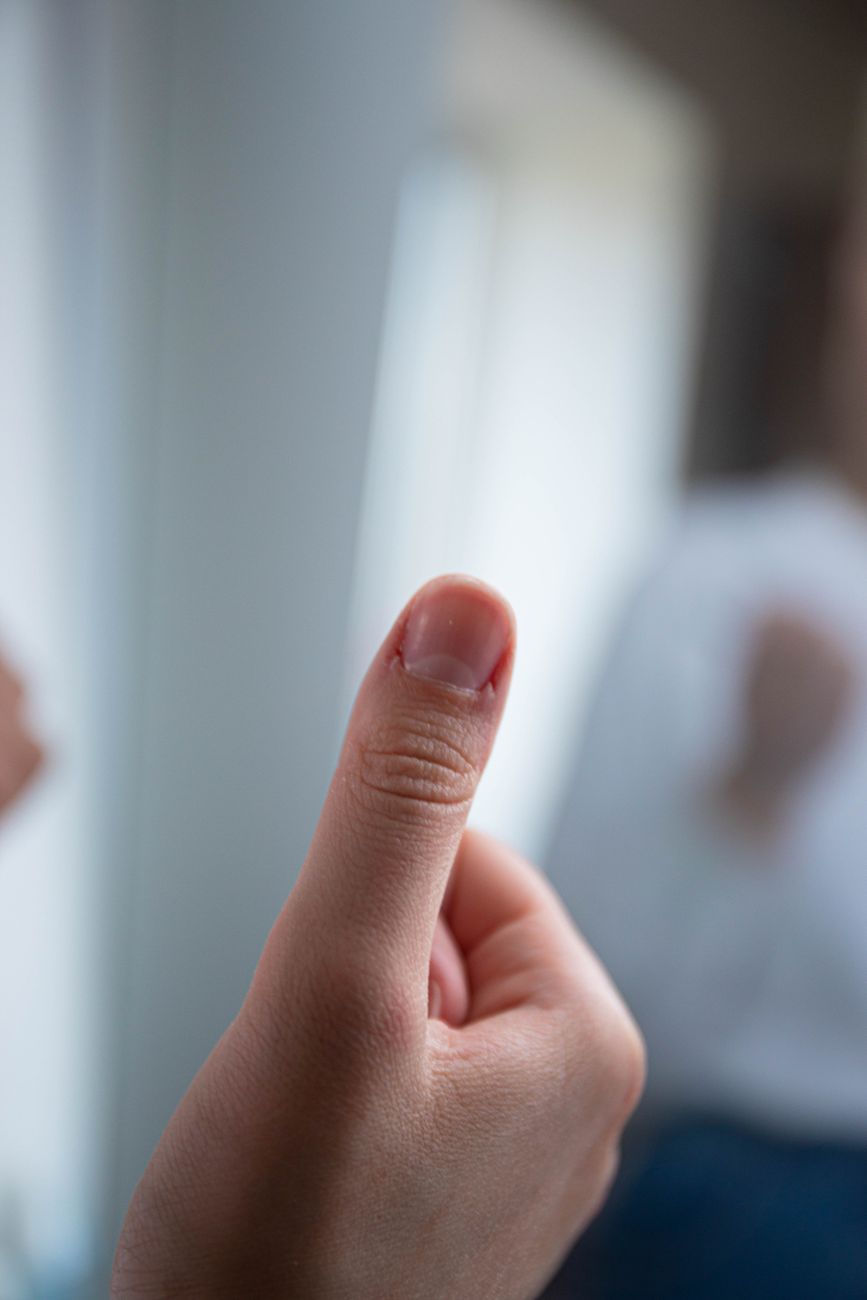
Got a red, throbbing swelling next to your fingernail — should you reach for a warm compress or an ice pack?
What Is a Paronychia?
A paronychia is an infection of the skin fold around a fingernail or toenail, usually caused by minor trauma like nail-biting, a hangnail, or aggressive manicuring that lets bacteria in. It shows up as redness, swelling, and tenderness along the nail edge, and can progress to a small pocket of pus if untreated.
Why Warm, Not Cold?
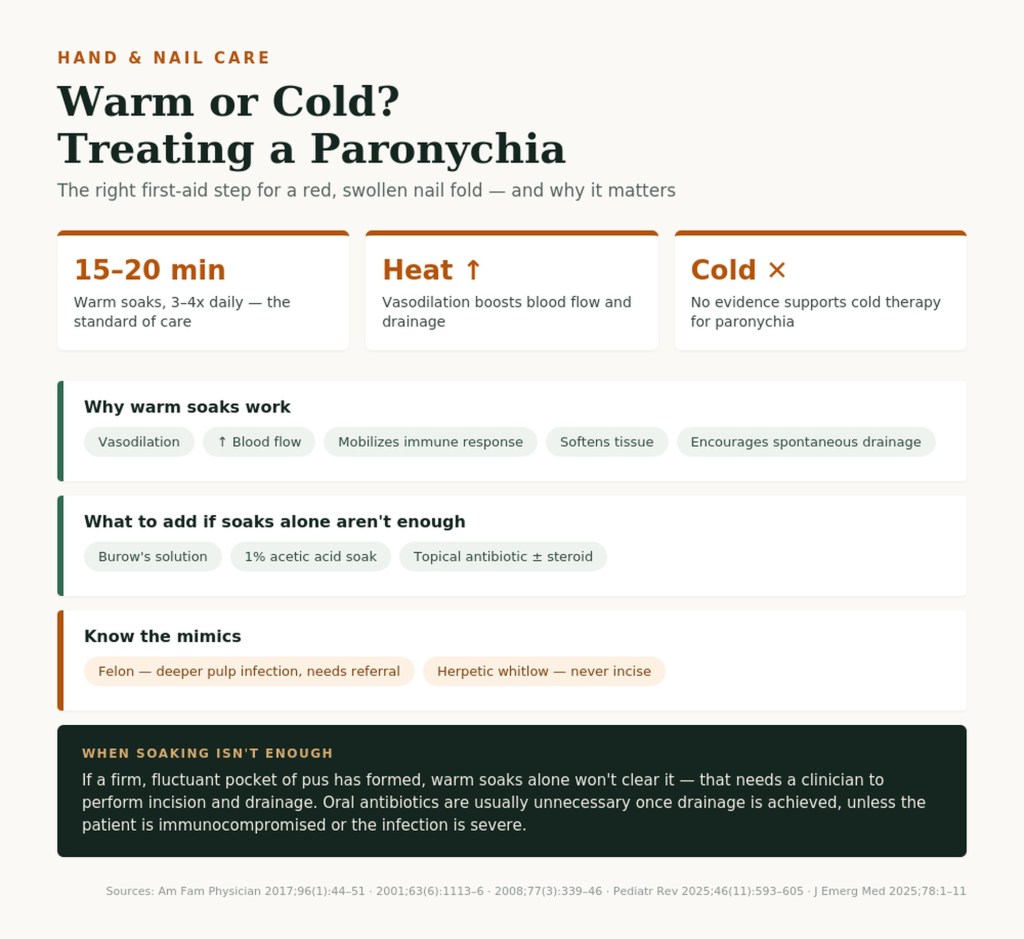
The standard of care is warm soaks, not cold ones — and the reasoning comes down to basic physiology. Heat causes local vasodilation, increasing blood flow to the infected area. That extra circulation helps mobilize the immune response, softens the tissue, and encourages any developing pocket of pus to mature and drain on its own.
Cold does the opposite. It constricts blood vessels, which would reduce blood flow right when the body needs more of it to fight the infection — and there’s no evidence it helps pus localize or drain. Across the literature on paronychia management, warm water soaks, warm compresses, and dilute vinegar (acetic acid) soaks are consistently the recommended conservative treatment. Cold therapy simply doesn’t appear as an option.
How to Do It Right
- Soak 3–4 times a day for about 15–20 minutes each time, using warm (not hot) water.
- Burow’s solution or a dilute (1%) acetic acid/vinegar soak can be used instead of plain water for early or mild infections.
- Topical antibiotics, with or without a topical steroid, can be added if soaks alone aren’t clearing the inflammation.
- Many mild-to-moderate paronychias resolve with soaking alone, sometimes avoiding the need for a doctor to lance it.
When Soaking Isn’t Enough
Soaks work for early, non-fluctuant infections — but if you can feel or see a distinct pocket of pus (fluctuance), warm water alone won’t fix it. That needs incision and drainage. Oral antibiotics generally aren’t necessary once drainage is achieved, unless you’re immunocompromised or the infection is severe.
It’s also worth knowing the mimics: a felon (a deeper infection of the fingertip pulp) needs prompt medical referral, and herpetic whitlow (a viral infection that looks similar) should never be incised — cutting it can worsen the infection and spread the virus.
The Bottom Line
If you notice a red, tender swelling next to a nail, warm soaks — not cold — are the evidence-based first step, because heat drives the blood flow and drainage the healing process needs. See a doctor if a firm pocket of pus develops, the redness spreads, or it doesn’t improve within a few days.
Related: Medical Self-Help
References
- Leggit JC. Acute and Chronic Paronychia. Am Fam Physician. 2017;96(1):44-51.
- Rockwell PG. Acute and Chronic Paronychia. Am Fam Physician. 2001;63(6):1113-6.
- Melnick A, Friedman J, Sokoloff WC. Office Minor Surgeries and Procedures. Pediatr Rev. 2025;46(11):593-605.
- Rigopoulos D, Larios G, Gregoriou S, Alevizos A. Acute and Chronic Paronychia. Am Fam Physician. 2008;77(3):339-46.
- Truong A, Miller A, Asch S. Pediatric Sports Dermatology. Pediatr Rev. 2024;45(5):271-284.
- Gottlieb M, Long B. Management of Finger Felons and Paronychia: A Narrative Review. J Emerg Med. 2025;78:1-11.





Leave a comment