
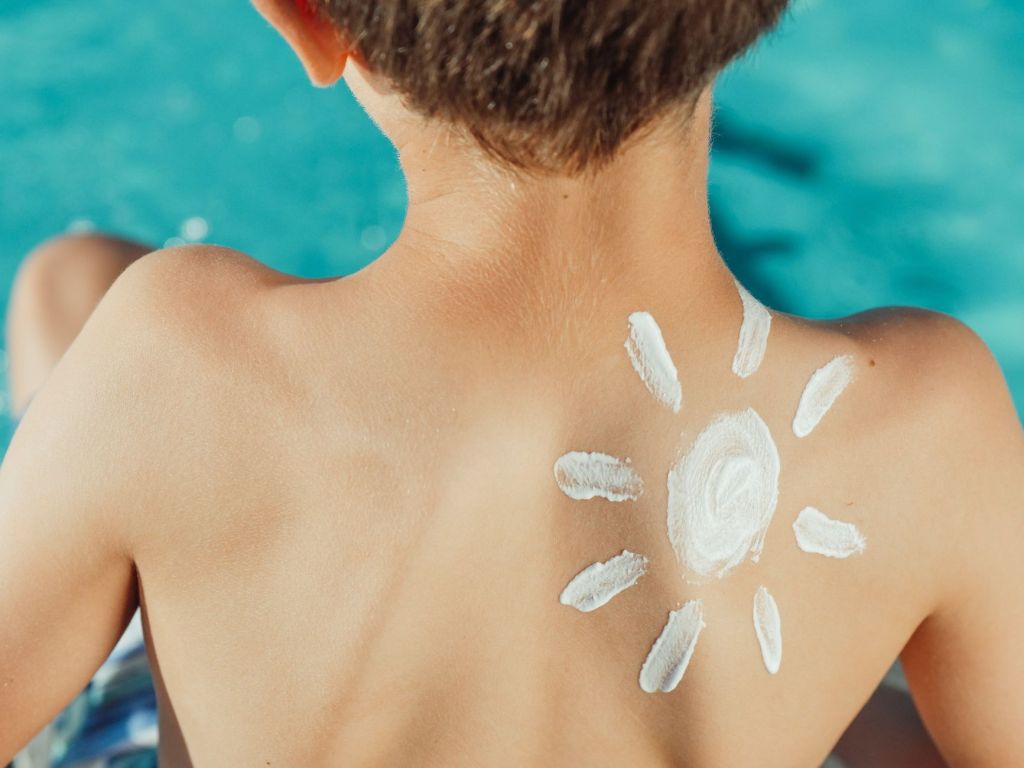
When it comes to blocking UV rays, is the shirt on your back doing a better job than the sunscreen in your bag?
A growing body of dermatology research says the answer might genuinely be yes — and it’s reshaping how experts think about sun protection.
The Head-to-Head Test
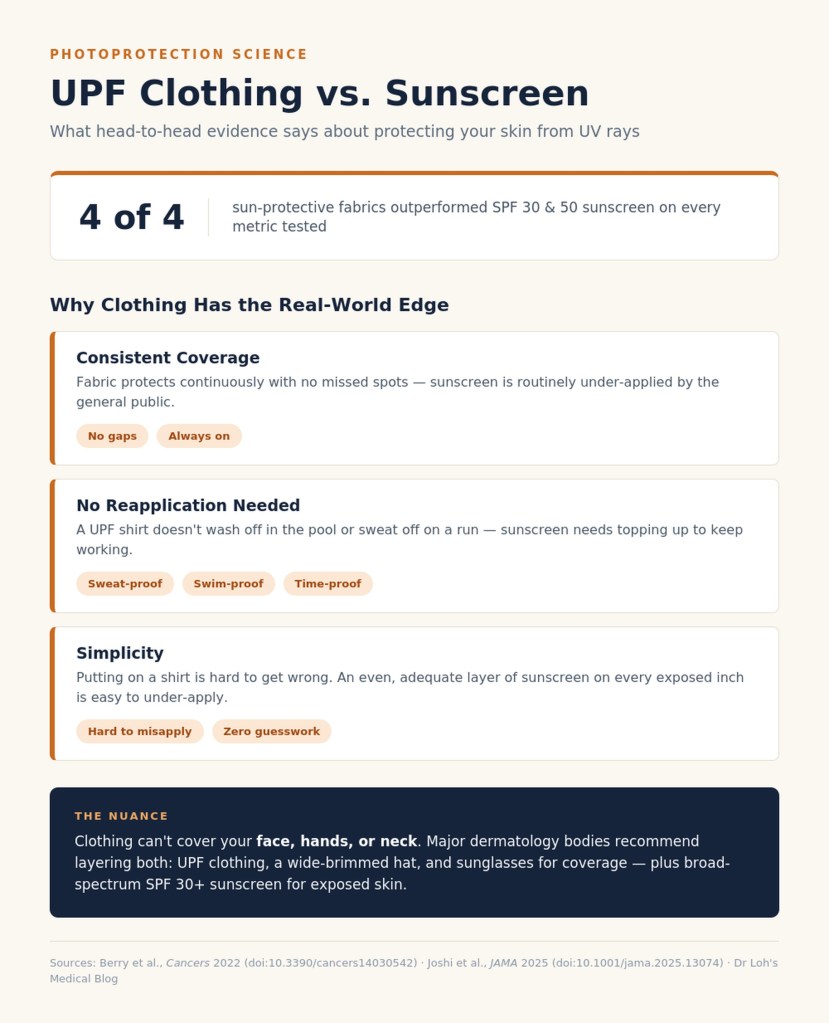
A laboratory study directly compared four modern sun-protective fabrics against two broad-spectrum sunscreens (SPF 30 and SPF 50). The textiles won on every metric measured — sun protection factor, critical wavelength, and percentage of UVA/UVB blocked — even when the sunscreens were applied at the “textbook” recommended thickness of 2 mg per square centimeter of skin, a density most people never actually achieve in real life.
The researchers’ conclusion was blunt: clothing should be considered the cornerstone of UV protection, with sunscreen serving as an important backup for the areas clothing can’t easily cover, like the face, hands, and neck.
Why Clothing Has a Real-World Edge
A few practical factors explain why fabric tends to outperform sunscreen outside the lab, not just inside it:
- Consistent coverage. Clothing protects continuously, with no gaps.
- No reapplication needed. A UPF shirt doesn’t wash off in the pool or sweat off on a run. Sunscreen does — and it only works as advertised if you put enough on to begin with and keep topping it up.
- Simplicity. Putting on a shirt is hard to get wrong. Applying an adequate, even layer of sunscreen to every exposed inch of skin, and remembering to redo it every two hours, is a lot easier to mess up.
Sunscreen Still Has a Proven Track Record
None of this means sunscreen is optional. A long-running Australian randomized controlled trial found that people who used sunscreen daily had significantly fewer invasive melanomas after 10 years of follow-up than those who used it only occasionally (0.37% vs. 1.36%), cutting risk by roughly 73%. That’s real, hard clinical evidence that sunscreen saves skin.
The takeaway isn’t “clothing instead of sunscreen” — it’s “clothing plus sunscreen, used where each does its job best.”
Putting It Into Practice
Major medical bodies, including the American Academy of Dermatology, the American Society of Clinical Oncology, and the World Health Organization, recommend layering both approaches:
- Sun-protective (UPF) clothing, a wide-brimmed hat, and UV-blocking sunglasses for the areas they can cover
- Broad-spectrum sunscreen, SPF 30 or higher, for exposed skin like the face, hands, and neck
- Seeking shade during peak UV hours, roughly 10 am to 2 pm
The Bottom Line
Sun-protective clothing isn’t just a convenient add-on to sunscreen — for the skin it covers, it’s often the more reliable option. The best strategy combines both: let fabric do the heavy lifting for your torso, arms, and legs, and reserve sunscreen for the skin you can’t easily cover up.
Related: Mole Patrol: Mastering the ABCDEs of Melanoma Detection
References
- Berry EG, Bezecny J, Acton M, et al. Slip Versus Slop: A Head-to-Head Comparison of UV-Protective Clothing to Sunscreen. Cancers. 2022;14(3):542. doi:10.3390/cancers14030542.
- Boothby-Shoemaker WT, Mohammad TF, Ozog DM, Lim HW. Photoprotection by clothing: A review. Photodermatol Photoimmunol Photomed. 2022;38(5):478-488. doi:10.1111/phpp.12776.
- Lautenschlager S, Wulf HC, Pittelkow MR. Photoprotection. Lancet. 2007;370(9586):528-537. doi:10.1016/S0140-6736(07)60638-2.
- Joshi UM, Kashani-Sabet M, Kirkwood JM. Cutaneous Melanoma: A Review. JAMA. 2025;334(23):2113-2125. doi:10.1001/jama.2025.13074.
- Pellacani G, Lim HW, Stockfleth E, et al. Photoprotection: Current Developments and Controversies. J Eur Acad Dermatol Venereol. 2024;38 Suppl 5:12-20. doi:10.1111/jdv.19677.




Leave a comment