

🚼💖 Hey, Super Moms! Ready to conquer the world of pumping and storing breast milk?
What is a breast pump?
This is a device that can remove (or “express”) milk from the breasts. The milk can be collected, stored, and fed to a baby later.
You might choose to pump:
- To help your breasts make more milk (if your milk supply is low)
- To have a supply of milk to give your baby when you can’t breastfeed (because of work, school, illness, travel, or other reasons)
- So your partner or another caregiver can feed the baby sometimes
- If you are having trouble breastfeeding, or prefer to bottle feed, but still want your baby to get the benefits of breast milk
You might also need to pump is if your baby is born too early (“premature”). Pumping helps build up your milk supply until your baby is ready to breastfeed. It also lets your baby get the benefits of breast milk.
What are the different types of breast pumps?
The right pump for you depends on why you need it and how often you will use it.
The different types of breast pumps include:
- Electric pumps that are used in hospitals – These are powerful and work the best to collect breast milk. They are often used by people whose babies need to stay in the hospital after birth. You can also rent these pumps to use at home.
- Personal electric pumps – These are smaller than hospital electric pumps. They can collect milk from 1 or both breasts at a time. They work quickly, but usually not as quickly as hospital pumps. Some personal pumps come in a carrying case or bag. They can be good for people who breastfeed sometimes but also need to pump at work or school.
- Single-sided pumps – These collect milk slower than hospital and personal electric pumps. They can be powered by hand, batteries, or electricity. They can be good for people who need to pump breast milk only once in a while.
How do I use a breast pump?
Each pump will have its own directions. But these are the general steps:
- Wash your hands with soap and water before pumping. If you are not near a sink, you can use hand gel with at least 60 percent alcohol. You do not have to wash your breasts or nipples.
- Make sure you have all your supplies. Make sure the pump pieces and the containers for storing the breast milk are clean.
- Make sure the cone-shaped pieces that fit over the breasts are the right size. These pieces are called “flanges.” Your nipple should not rub against the tunnel part of the flange (see picture below)
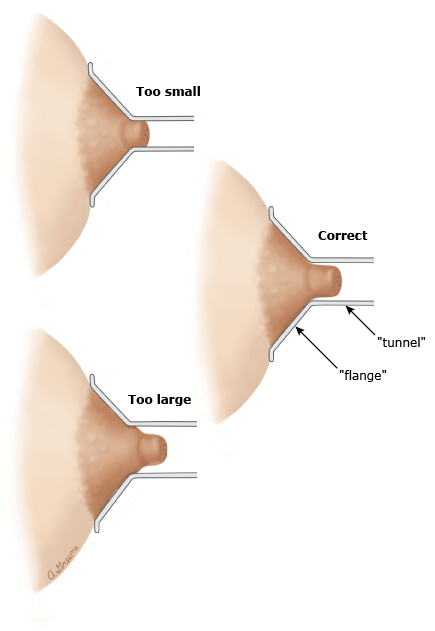
- Connect the pieces if needed, and put the flange over your nipple. Make sure the container is attached and ready to collect the milk. Some people buy a special bra with holes that hold the flanges in place. This lets you have your hands free while you pump.
- Start at a low speed and suction. Within a few minutes, milk should start to flow from your breasts. It can take some practice to get used to the right pump settings for you.
- If the milk is not flowing easily, you can do things to help your breasts “let down” the milk. Let-down is when the milk flows from the milk glands into the milk ducts. Usually, this happens soon after you start pumping. But if it doesn’t, it might help to:
- Massage your breasts gently before you pump.
- Put a warm wet cloth on your breasts before you pump.
- Pump in a dark and quiet room.
- Look at a picture of your baby when you start pumping.
- When you are done pumping, carefully close the milk containers so you can store them. Clean the pump parts before using them again.
If I don’t have a pump, can I use my hand to express milk?
Using a pump is the best way to empty the breasts quickly and completely. But in some situations, you might need or want to express milk without a pump. This is also called “hand expression.”
Some people express milk by hand during the first few days after a baby is born to help their milk come in. It can also help relieve discomfort if your breasts are very full and you cannot pump or feed.
To express milk using your hands:
- Wash your hands with soap and water.
- Have a clean container ready to catch the milk.
- Gently massage your breasts to help “let down” the milk.
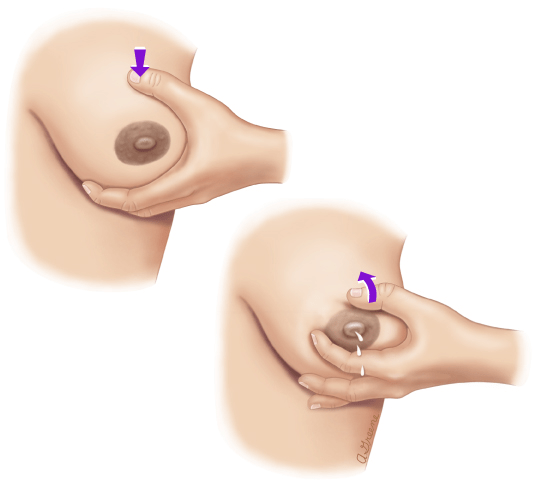
- Hold your breast with your fingers and thumb in a “C” shape.
- Press gently on your breast straight back into the chest. Then, roll your thumb and fingers toward your nipple so milk comes out.
- Repeat while moving your hand around your breast. Continue until the milk stops flowing, or until you have expressed the amount you want.
How should I store breast milk?
Breast milk can be safely stored:
- At room temperature for up to 4 hours
- In the refrigerator for up to 4 days
- In the freezer for up to 9 months
Some tips for storing milk:
- You can store milk in clean glass or plastic bottles with secure lids, or in plastic bags.
- It can help to store breast milk in small amounts.
- Write the date the milk was pumped on each container. Then, you can use the oldest milk first.
- Some hospitals have different rules for storing breast milk. If your baby is in the hospital, check with the doctor or nurse.
How do I warm up stored breast milk?
When it is time to give the milk to your baby:
- Warm up breast milk from the freezer or refrigerator slowly – Do not put breast milk in the microwave. Instead, fill a small pot or container with warm water and put the bottle in it. Do not let the whole bottle go under water.
- Swirl the milk around gently to make sure the temperature is even.
- Test the temperature of the milk before feeding it to your baby. The milk should be a little bit warm or at room temperature. Make sure it is not too hot.
How do I prepare to pump at work?
Pumping at work (or school) can be time-consuming and sometimes stressful. It can help to remember you are giving your baby all the health benefits of breast milk, even when you can’t breastfeed.
Some tips that might help:
- Talk to friends or coworkers who have experience pumping at work.
- If possible, start pumping 2 to 4 weeks before going back to work. This lets you get used to using the pump.
- Talk with your coworkers about when and where you can pump. By law, your work needs to give you breaks so you can pump. Your work also needs to give you a private place to pump.
- Make sure you have a place to store your pumped milk until you get home. This might be a refrigerator, or a cooler you bring with you.
- If you are worried about leaking milk at work, you can put breast pads in your bra. These will help soak up any leaked milk and protect your clothing.
Conclusion
Pumping and storing breast milk can provide you with flexibility while ensuring your baby receives all the benefits of breastfeeding. With the right techniques and storage methods, you can make this process smooth and stress-free. Remember, every drop counts, so don’t be discouraged if things don’t go perfectly at first!
Happy pumping! 🍼✨
Related: When Should My Baby Start Solid Foods?, What Food And Drinks Should My Baby Avoid?, What Should I Know About Baby Food Allergy?, Does My Baby Need Mineral/Vitamin Supplements?, Mother’s Nutrition During Breastfeeding, Breastfeeding Basics and For Parents






Leave a comment