

👶✨ Ready to embark on your breastfeeding journey?
Do doctors recommend breastfeeding for most babies?
Yes. Doctors recommend breastfeeding your baby for at least 1 year (12 months) if possible. For the first 6 months, breast milk is the only food a baby needs. Most babies start eating other foods, in addition to breast milk, when they are 4 to 6 months old.
What is exclusive breastfeeding?
This means your baby only drinks breast milk, and no formula or water. Any amount of breastfeeding is good for your baby. But exclusive breastfeeding gives the most benefits.
What are the benefits for the baby?
For babies, breastfeeding can help:
- Prevent stomach infections that can cause vomiting or diarrhea
- Prevent ear or lung infections
- Lower the risk of SIDS – This is when a baby younger than 1 year old dies suddenly for no known reason.
- Breastfeeding might also help babies gain weight at a healthy rate as they grow.
What are the benefits for the mother?
Compared with people who feed their babies formula, people who breastfeed usually:
- Have less bleeding from the uterus after giving birth
- Have less stress
- Lose more weight after pregnancy
- Don’t spend as much money to feed their baby
- Don’t spend as much money on health care or miss as much work, because their babies get sick less often
- Have a lower chance of getting breast, ovarian, or endometrial (uterine) cancer
When to start breastfeeding?
If possible, it’s best to start immediately after giving birth, ideally within the first hour. During this time, most babies are awake and want to breastfeed. Also, the “skin-to-skin contact” can help your baby learn to breastfeed.

After you give birth, hormone changes in your body make your breasts fill with milk. For the first few days after birth, you will make only a small amount of yellowish milk. This is called “colostrum.” It has all the nutrition a newborn needs. You will start making more breast milk a few days later, usually 2 to 3 days after giving birth.
Breastfeeding frequently helps your body make more milk. If you want to keep breastfeeding, try not to give your baby any formula, unless there is a medical reason. “Supplementing” with formula can make it harder for your body to make enough milk.
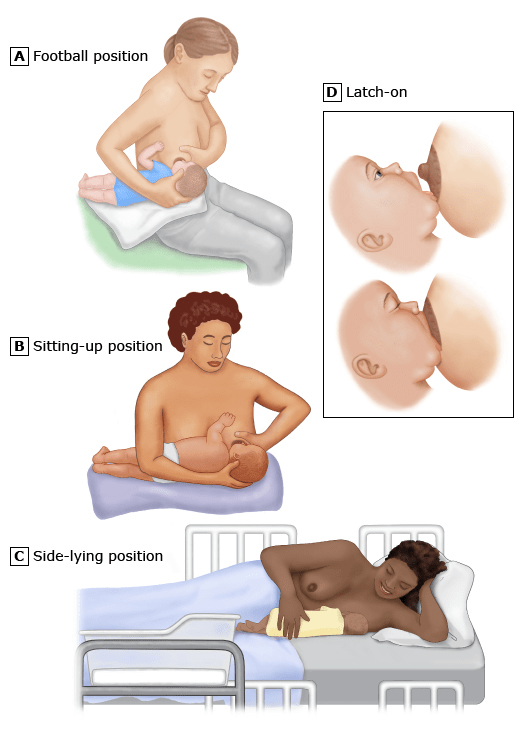
How to hold the baby during breastfeeding?
You can try different positions to figure out which way works best for you and your baby.
Some people wear a “nursing bra.” The cups of the bra have special flaps that open. This way, you can breastfeed your baby without having to take the bra off. Wearing a nursing bra might also give your breasts extra support.
What is “latch-on”?
This is when a baby makes a tight seal with their mouth around the nipple and the areola (the dark skin around the nipple):

A good latch-on helps the baby get enough milk and helps protect your nipples. You might feel a tugging or pulling at your nipples. If you feel pain or rubbing, take the baby’s mouth off your breast, then have them latch on again.
How often to breastfeed, and how long should a feeding last?
You should breastfeed when your baby shows signs of being hungry. They might:
- Wake up from sleep
- Move their head around as if looking for the breast
- Suck on their hands, lips, or tongue
Babies can breastfeed on different schedules and for different amounts of time. For example, some babies finish a feeding in 5 minutes, but others might take 20 minutes or longer. Newborn babies feed about 8 to 12 times each day.
It’s a good idea to let the baby finish breastfeeding on 1 side so they get all the milk from that breast. Then, you can see if your baby wants to drink from your other breast. The next time you breastfeed, try to remember which breast your baby started on the last time, and start on the other side. Switching the side you start with each time helps both your breasts continue to make milk.
Is the baby getting enough breast milk?
You can tell if your baby is getting enough breast milk by:
- Checking their diapers – By day 4 or 5 after birth, babies should have at least 4 or 5 wet diapers a day.
- Checking their bowel movements – Newborns should have at least 1 bowel movement every day. By day 5, they usually start to have more bowel movements, and their bowel movements should be yellow.
- Having your doctor or nurse check to see if your baby is gaining weight
Certain things can cause you to have trouble making enough milk. This can happen if:
- You don’t breastfeed often enough.
- Your baby has trouble getting milk during breastfeeding.
- You are tired, sick, or under a lot of stress.
- You take certain medicines.
- You smoke cigarettes.
- You had certain types of breast surgery.
Does the baby need any other food or drink?
For the first 6 months, most babies need only breast milk. Babies who breastfeed also need to take extra vitamin D. (Read: Does My Baby Need Mineral/Vitamin Supplements?)
When a baby is between 4 and 6 months old, they can start eating and drinking other things, too. You can still continue to breastfeed after your baby starts eating solid foods. (Read: When Should My Baby Start Solid Foods?)
What problems can happen during breastfeeding?
Some people have problems during breastfeeding, like:
- Swollen, hard, and painful breasts
- Painful or cracked nipples
- Breast or nipple infections
- Narrowing of the milk ducts, which can cause red and painful breast lumps
How are breastfeeding problems treated?
It depends on the problem. For example, if you have swollen, hard, and painful breasts, you might feel better if you:
- Use your hand or a breast pump to let some milk out
- Put a cold pack or cool cloth on your breasts, or take pain medicine.
Talk with your doctor or nurse if you are having problems with breastfeeding. Almost all breastfeeding problems can be treated. It might help to talk with a breastfeeding expert, called a “lactation consultant.”
Read: Mastitis Management: Essential Do’s and Don’ts for Nursing Moms
When to see a doctor?
Call your doctor if you have:
- Pain that lasts for the whole breastfeeding session
- Blood leaking from your nipples
- A swollen area in your breast that does not get better
- A fever of 100.4°F (38°C) or higher, and a hard, red, or swollen area of your breast
- Flu-like symptoms, including muscle aches, chills, or feeling very tired
- Concern you are not making enough milk
Should I change my diet while breastfeeding?
Maybe. Eat a healthy diet, and drink plenty of liquids. If you are trying to lose weight, breastfeeding might help. If you have a restrictive diet (for example, you avoid meat or animal products), talk to your doctor or nurse. They might suggest taking iron or certain vitamins while breastfeeding to make sure you get the nutrients you need.
If you drink alcohol, most doctors recommend having only an occasional drink that has the amount of alcohol found in 1 glass of wine. They also recommend waiting 2 hours after having a drink before breastfeeding.
Can I keep taking my medicines while I am breastfeeding?
Some medicines are not safe while you are breastfeeding. If you take any medicines, tell your doctor or nurse. They can make sure those medicines are safe to take when breastfeeding. They might be able to switch your medicines.
When should I stop breastfeeding?
If possible, it is a good idea to keep breastfeeding until your baby is at least 1 year old. But people choose to stop breastfeeding at different times and for different reasons.
When you decide to stop, doctors recommend doing it gradually. You can drop 1 feeding every 2 to 5 days, or breastfeed for a shorter time each feeding. This makes it easier for your body to adjust. It will also give your baby time to get used to breastfeeding less.
Conclusion
Breastfeeding is a journey filled with ups and downs, but with patience and support, it can be one of the most rewarding experiences of motherhood. Remember to take care of yourself too—stay hydrated, eat well, and don’t hesitate to reach out for help if needed!
Related: When Should My Baby Start Solid Foods?, What Food And Drinks Should My Baby Avoid?, What Should I Know About Baby Food Allergy?, Does My Baby Need Mineral/Vitamin Supplements?, Mother’s Nutrition During Breastfeeding, Breastfeeding Basics and For Parents





Leave a comment